Screen Printing vs DTF: Which T-Shirt Printing Method Should You Choose?
Quick Answer
Screen printing pushes thick ink through a separate screen per colour best for bold solid colours, Pantone matches, specialty effects, and large, highly durable bulk runs. DTF (Direct to Film) prints your design onto a film and heat-presses it on, handling unlimited colours, fine detail, and almost any fabric with no minimum order, but with a slightly plastic feel and slightly lower long-term durability. Choose DTF for small, colourful, mixed-fabric jobs and screen printing for large, simple, high-durability runs.
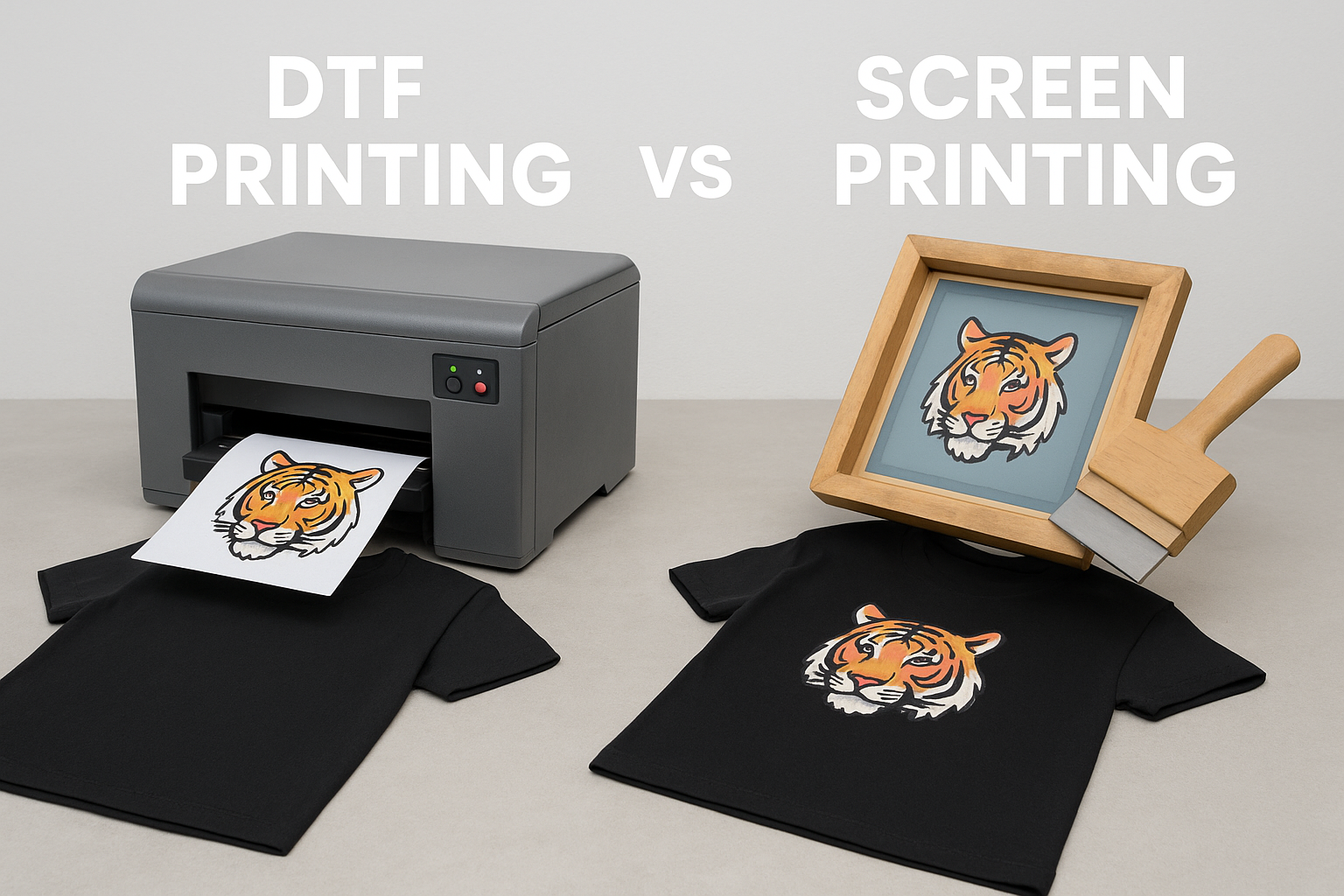
If you are looking into custom t-shirt printing, two methods keep coming up in every conversation: screen printing and DTF. Screen printing has been the industry standard for decades. DTF Direct to Film is the newer method that has exploded in popularity over the last few years, especially among small brands and independent sellers.
Both can produce great looking t-shirts. But they work in fundamentally different ways, and the right choice depends on what you are printing, how many you need, and what kind of quality you expect.
This guide breaks down how each method works, where each one excels, and what their real-world limitations are so you can make an informed decision before spending money on your next print run.
What Is Screen Printing?
Screen printing is the oldest and most established method of printing on fabric. It has been used commercially since the early 1900s and remains the dominant method for large-scale apparel production.
The process uses a mesh screen stretched over a frame. A stencil of your design is created on the screen using a light-sensitive emulsion. Ink is then pushed through the open areas of the mesh onto the fabric below using a squeegee.
Each colour in your design requires its own screen. A four-colour design means four separate screens, four ink passes, and four alignment steps. This is why screen printing has high setup costs but becomes very efficient at scale.
Key characteristics of screen printing
- Uses thick plastisol or water-based inks
- Each colour requires a separate screen
- Ink sits on top of the fabric surface
- Prints have a slightly raised, tactile feel
- Extremely durable when done properly
- Setup is time-consuming but per-unit cost drops significantly with volume
What Is DTF Printing?
DTF stands for Direct to Film. Unlike screen printing, which pushes ink through a stencil onto the shirt, DTF prints your design onto a special PET film first, applies a hot-melt adhesive powder, and then heat presses the transfer onto the garment.
The process is entirely digital. Your design goes from a computer file to a printed film without any screens, stencils, or manual colour separation. A modified inkjet printer lays down CMYK and white ink onto the film, the adhesive powder is applied and cured, and the finished transfer is pressed onto the t-shirt.
Key characteristics of DTF printing
- Prints onto a PET film first, then transfers to the garment
- Uses CMYK plus white ink
- No screens or manual setup required
- Works on virtually any fabric type and colour
- Prints have a smooth, slightly plasticky feel
- Transfers can be pre-made and stored for later application
Screen Printing vs DTF: The Full Comparison
Print quality and detail
Both methods can produce sharp, vibrant results, but they handle detail differently.
Screen printing produces bold, saturated colours that are hard to match with any other method. The thick ink deposit means colours look rich and solid, especially on dark garments. However, fine detail is limited by the mesh count of the screen. Very thin lines, tiny text, and subtle gradients are difficult to reproduce cleanly. Halftone techniques can simulate gradients, but they require skill and the results are never truly smooth.
DTF handles detail and complexity much better. Because it prints digitally, it can reproduce photographic images, smooth gradients, and intricate patterns with ease. Small text, fine lines, and complex multi-colour artwork all come out clean. The trade-off is that colours can sometimes look slightly less vibrant than screen printing's thick ink layers, particularly on dark shirts where the white base layer affects the final colour.
Best for fine detail and complex designs: DTF Best for bold, saturated solid colours: Screen printing
Colour range and flexibility
Screen printing charges per colour. Each additional colour means a new screen, more setup, and more production time. This makes it cost-effective for one to four colour designs but increasingly expensive beyond that. Specialty colours like Pantone matches are possible by mixing custom inks something DTF cannot do.
DTF uses a CMYK process, so the number of colours in your design is irrelevant to cost. A two-colour logo costs the same to print as a full-colour photograph. This makes DTF the obvious choice for multi-colour and photographic designs.
Best for unlimited colours: DTF Best for exact Pantone colour matching: Screen printing
Feel and hand
This is one of the most noticeable differences between the two methods, and it matters more than most people expect.
Screen printing with plastisol ink has a slightly raised, rubbery feel on the fabric. You can feel the ink when you run your hand over the print. Water-based screen printing inks produce a softer feel that soaks into the fabric, but they are less common and more difficult to work with on dark garments.
DTF transfers have a smooth, uniform feel. The adhesive layer creates a thin film over the printed area. On a fresh print, this can feel slightly plastic or vinyl-like. With washing, it softens somewhat, but it never fully achieves the soft hand feel of water-based printing methods like DTG.
If you pick up a DTF printed shirt and a screen printed shirt side by side, you will notice the DTF print feels like a sticker on the fabric smooth and uniform while the screen print feels more like ink on fabric, with texture you can feel under your fingers.
Best for soft hand feel: Screen printing (water-based) or DTG Most noticeable on the fabric: DTF (film-like feel)
Durability and wash performance
Screen printing is the durability champion. Properly cured plastisol ink can withstand hundreds of washes without significant fading or cracking. The ink bonds mechanically with the fabric surface and the thick deposit means colours stay vibrant over time. There is a reason every major apparel brand still uses screen printing for their core product lines.
DTF is durable but does not quite match screen printing's longevity. The adhesive bond is strong initially, but over time and repeated washing, the edges of the transfer can begin to lift or crack, particularly on designs with hard edges or fine details at the perimeter. The printed area can also develop a worn, slightly crackled texture after extended use.
DTF durability has improved significantly with advances in adhesive powder and curing technology, but in a head-to-head wash test, screen printing still comes out ahead.
Best for long-term durability: Screen printing Good durability with proper care: DTF
Fabric compatibility
This is where DTF has a significant advantage.
Screen printing works best on cotton and cotton-blend fabrics. It can print on polyester, but requires special inks and processes to prevent dye migration a phenomenon where the polyester dye bleeds into the printed ink, causing colour shifting and discoloration.
DTF works on virtually everything. Cotton, polyester, nylon, blends, canvas, denim the heat-applied adhesive bonds to nearly any fabric type. This makes DTF extremely versatile for custom printing across different garment types.
If you want to print on a polyester sports jersey, a nylon bag, and a cotton t-shirt using the same method, DTF is your only practical option without specialized equipment for each fabric.
Best for cotton: Both Best for polyester and mixed fabrics: DTF
Cost structure
The cost comparison depends entirely on order volume.
Screen printing has high fixed costs (screen creation, ink mixing, press setup) but very low variable costs per shirt once running. The breakeven point where screen printing becomes cheaper than DTF is typically around 25 to 50 units for a simple design, and 50 to 100 units for complex multi-colour designs.
DTF has virtually no setup cost. Each transfer costs roughly the same whether you make one or one thousand. This makes it extremely cost-effective for small runs and one-off pieces, but it never achieves the same per-unit economy as screen printing at high volume.
| Order Size | Screen Printing | DTF |
|---|---|---|
| 1-10 units | Expensive (setup cost spread thin) | Affordable |
| 10-50 units | Moderate | Affordable |
| 50-200 units | Cost-effective | Moderate |
| 200+ units | Very cost-effective | Less competitive |
Best for small orders (under 50): DTF Best for large orders (200+): Screen printing
Production speed
Screen printing is slow to set up but fast to run. Creating screens, mixing inks, and aligning the press can take an hour or more. But once the press is running, an experienced operator can print hundreds of shirts per hour. For large orders, it is the fastest method available.
DTF is fast to start but slower per unit. There is no setup time send the file, print the film, press the transfer. But each transfer must be individually heat pressed onto each garment, which creates a bottleneck at scale. Automated DTF lines are improving this, but they still cannot match the throughput of a multi-station screen printing press.
Best for quick turnaround on small orders: DTF Best for high-volume production speed: Screen printing
Specialty effects
Screen printing offers a range of specialty inks and techniques that DTF simply cannot replicate:
- Metallic and foil inks for reflective, shiny effects
- Puff ink that expands when heated to create a raised 3D texture
- Glow-in-the-dark ink for novelty and event merchandise
- Discharge printing that removes the fabric dye for a vintage, soft feel
- Flocked prints with a velvet-like texture
- Shimmer and glitter inks for textured sparkle effects
DTF is limited to standard CMYK colour reproduction. Some DTF printers can incorporate metallic or fluorescent inks, but the range of effects is far narrower than what screen printing offers. If your design requires a specialty finish, screen printing is likely your only option.
Best for specialty effects: Screen printing (no contest)
Quick Decision Guide
Choose screen printing if:
- You are ordering 50+ units of the same design
- Your design has four or fewer colours
- You need Pantone-matched colours
- You want specialty effects (metallic, puff, glow)
- Maximum durability is your priority
Choose DTF if:
- You are printing small batches or one-offs
- Your design has many colours, gradients, or photographic elements
- You need to print on polyester or mixed fabrics
- You need fast turnaround with no minimum order
- You want consistency across different fabric types
What About DTG?
You might be wondering where DTG (Direct to Garment) fits into this comparison. DTG prints directly onto the garment using water-based inks no film, no transfer, no adhesive layer. It produces the softest hand feel of all three methods because the ink soaks into the fabric fibres rather than sitting on top.
DTG excels on cotton, handles unlimited colours like DTF, and requires no setup like DTF. The trade-off is that it works best on cotton and high-cotton blends, and it requires careful garment pre-treatment.
At ModBlitz, we use DTG printing for our custom tees because it delivers the best combination of print quality, soft feel, and durability on the premium cotton shirts we use. The print becomes part of the fabric rather than a layer on top of it, which is exactly what we want for streetwear that you wear every day not just once.
Ready to Print Your Design?
Whether you have a finished design or just an idea, we can help you get it onto a premium quality t-shirt.
Design Your Own Tee at ModBlitz →
Upload your artwork, pick your size and colour, and we handle the rest. No minimum orders. Island-wide delivery across Sri Lanka.
Want to see our printing quality in person? Check out our latest collection every design is DTG printed on heavyweight cotton.
Frequently Asked Questions
Is DTF or screen printing more durable?
Screen printing. Properly cured plastisol ink withstands hundreds of washes without significant fading or cracking. DTF is durable with proper care, but its transfer edges can begin to lift or crack over time, so screen printing wins a head-to-head wash test.
Which is cheaper, screen printing or DTF?
It depends on volume. DTF has almost no setup cost, so it is cheaper for small runs and one-offs. Screen printing's per-shirt cost drops with volume, becoming cheaper at roughly 25 to 50+ units for a simple design and 50 to 100 units for complex ones.
Can DTF print on polyester and mixed fabrics?
Yes. DTF's heat-applied adhesive bonds to virtually any fabric cotton, polyester, nylon, blends, canvas, and denim. Screen printing works best on cotton and needs special inks and processes for polyester to avoid dye migration.
What does a DTF print feel like compared to screen printing?
A DTF transfer has a smooth, uniform, slightly plastic or vinyl-like feel, like a thin film over the print. Screen printing with plastisol feels slightly raised and textured, while water-based screen printing and DTG feel softer.
Which method does ModBlitz use, and why not DTF?
ModBlitz uses DTG (Direct to Garment), not DTF. DTG prints water-based ink directly into cotton fibres for the softest feel, unlimited colours, and no setup the print becomes part of the fabric rather than a layer sitting on top of it.